Now through October 31, we're waiving application fees for all domestic freshman and transfer applicants!
*Common app code: Central27
/biololgy-ms-6a081f1f-0a92-46dd-9170-6a2e241b22c4.webp?sfvrsn=4b176798_10)
Biology
Master's
Michigan: A biologists dream laboratory
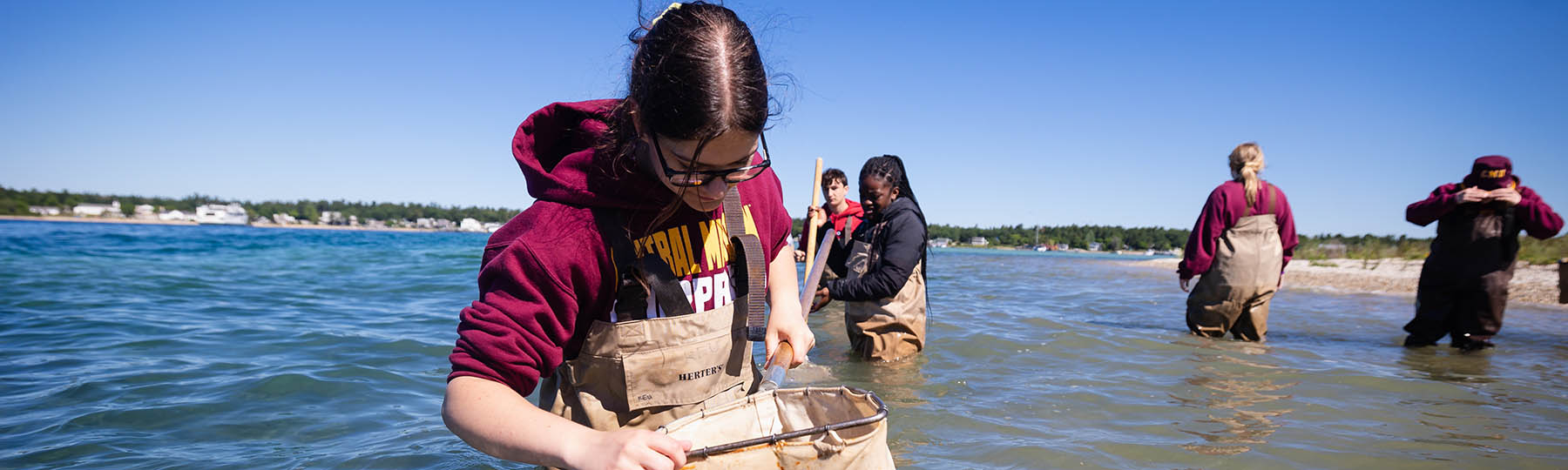
Our biology labs are as big as the Great Lakes. Literally. See how much you can accomplish when your research program has its own biological station on Lake Michigan, is a recognized expert in preserving wetlands, and is surrounded by biodiversity fueled by four distinct seasons and the longest freshwater shoreline in the world.
AT A GLANCE
Degree Type
Master of Science (M.S.)
Format
On Campus
Credit Hours
30 Credit Hours
Why choose CMU for your master's in biology?
At CMU, a master’s degree in biology is more than just coursework. It’s an opportunity to immerse yourself in a community of passionate scientists, guided by world-class faculty and equipped with cutting-edge resources. Whether you’re fascinated by microbes, inspired by conservation efforts or eager to further understand any number of living organisms, our program empowers you to make an impact.
Here's what sets CMU apart from the rest:
Unrivialed research opportunities
- Work where science thrives: CMU is among the top 10% of U.S. research institutions with a prestigious Carnegie research classification. Imagine working alongside faculty on advanced research in cellular and molecular biology, microbiology, genetics, physiology and more.
- A biological station like no other: Research Michigan's natural ecosystems at CMU’s Biological Station on Beaver Island in Lake Michigan. Explore cedar swamps, traverse sand dunes or take to the water aboard our MV Chippewa research vessel.
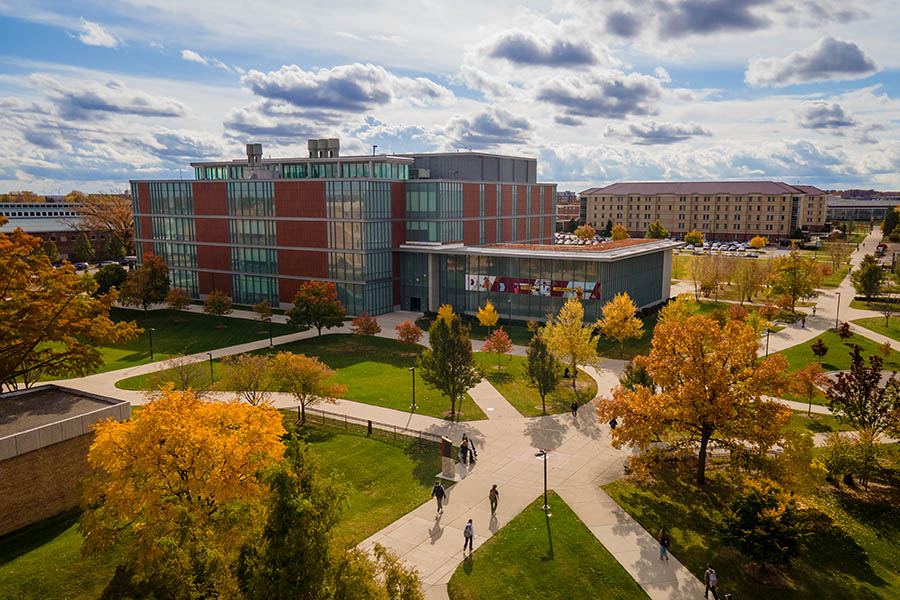
- State-of-the-art facilities: Our four-story, 169,000-square-foot Biosciences Building features a vivarium, herbarium, microscopy labs and the resources you need to push scientific boundaries.
Program options tailored to you
We understand every student’s goals are unique. That’s why we offer two program tracks designed to meet your goals:
- Thesis option (Plan A): Perfect for those pursuing research-focused careers or further academic studies. You’ll focus on conducting meaningful research and writing a thesis, all while collaborating directly with faculty mentors.
- Non-Thesis option (Plan B): Ideal for those targeting professional roles, this 36-credit option emphasizes applied learning through minor research or independent study.
What you'll experience at CMU
- Learning beyond the classroom: Here, the lab transcends traditional boundaries. Whether you’re analyzing data from our biological station or studying samples from Lake Michigan, you’ll apply your knowledge in real-world environments.
- Support from day one: Faculty who care, peers who inspire, and a community passionate about science and discovery.
- A career-boosting degree: Graduates from our program step into roles as conservationists, researchers, government specialists, and more. Many also pursue advanced degrees, carving out their place as leaders in biology.
Concentrations
Filter Concentrations by Location:
Conservation Biology
Careers protecting the environment start here. Learn the latest field techniques and conduct research at our new Biosciences Building or our biological station on Beaver Island. When you graduate with a concentration in conservation biology, you'll be ready for a career at a conservation agency or in government, or to pursue a Ph.D.
Accelerated biology degree
Get where you want to go faster with an accelerated master’s program. You may be able to double-count 15 credits with Plan A or 18 credits with Plan B.
By double-counting all 15 credits in Plan A, domestic students save up to $4,155 and international students save up to $1,560. By double-counting all 18 credits in Plan B, domestic students save up to $4,986 and international students save up to $1,872.
Career paths in biology
An M.S. in Biology will equip you to start a career in the lab or the field.
| Career | Projected Salary |
|---|---|
| Biologist | $72,860 |
| Research Scientist | $100,590 |
| Natural Science Research Director | $80,060 |

CMU biology student's work on canabalism in mouthbrooding fish nationally recognized
A love of fish led CMU graduate student, Jake Sawecki to discover the surprising way some African cichlid fish relieve the stress of mouthbrooding their young. His research has been featured in National Geographic, New Scientist, Smithsonian Magazine and the Canadian national news show “As It Happens.”
Request Information about CMU
Loading...
By submitting this form, I agree to receive calls, emails and/or text messages from Central Michigan University to discuss furthering my education.